Rules
Deck and deal
Three players, a 24-card deck: 9, J, Q, K, 10 and A in four suits. Everyone gets 7 cards and three go face down on the table as the musik.
Card values: ace 11, ten 10, king 4, queen 3, jack 2, nine 0. The cards hold 120 points in total — the rest comes from melds.
Bidding
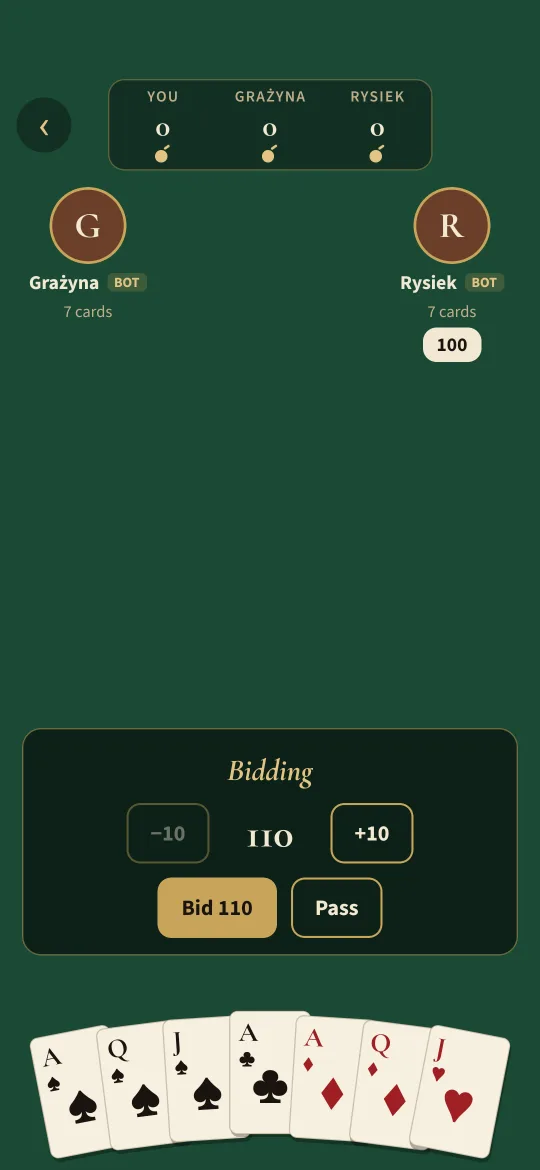
Bidding starts at 100 and goes up in tens, as far as 360. Whoever opens must bid exactly 100 — passing is not allowed. Once you pass, you are out of the auction.
To bid above 120 you must hold a meld: a king and a queen of the same suit.
Holding four nines entitles you to demand a fresh deal.
Musik and declaration
Whoever wins the auction turns the musik face up — everyone sees it — and takes those three cards, bringing their hand to ten. Then they pass one card to each opponent. Everyone at the table now holds eight cards, and the deal runs for eight tricks.
Finally the declarer says how much they play for. The declaration goes in tens and can never be lower than the winning bid. You may raise it if the musik was kind.
Melds and trump
A king and a queen of the same suit form a meld: hearts 100, diamonds 80, clubs 60, spades 40.
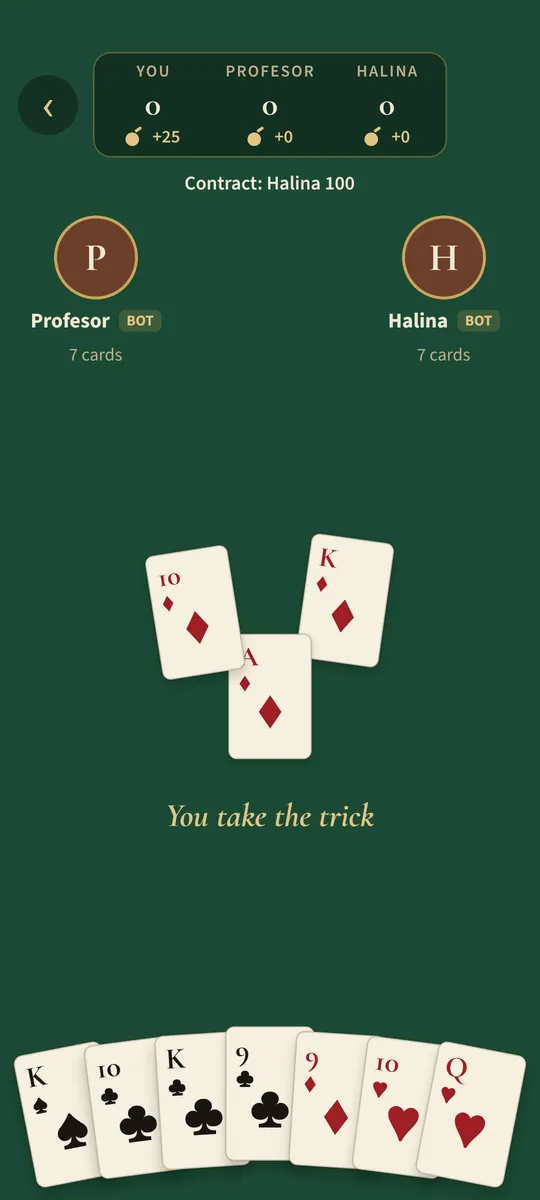
You meld by leading a trick with that king or queen — from the second trick onwards. The points are banked the moment the card is played, even if somebody else takes the trick.
The melded suit becomes trump and stays trump until the next meld.
Play
You must follow suit. If you can beat the card currently winning the trick, you must.
Out of the suit: you must play a trump. If a trump is already in the trick and you can beat it, you must do that too.
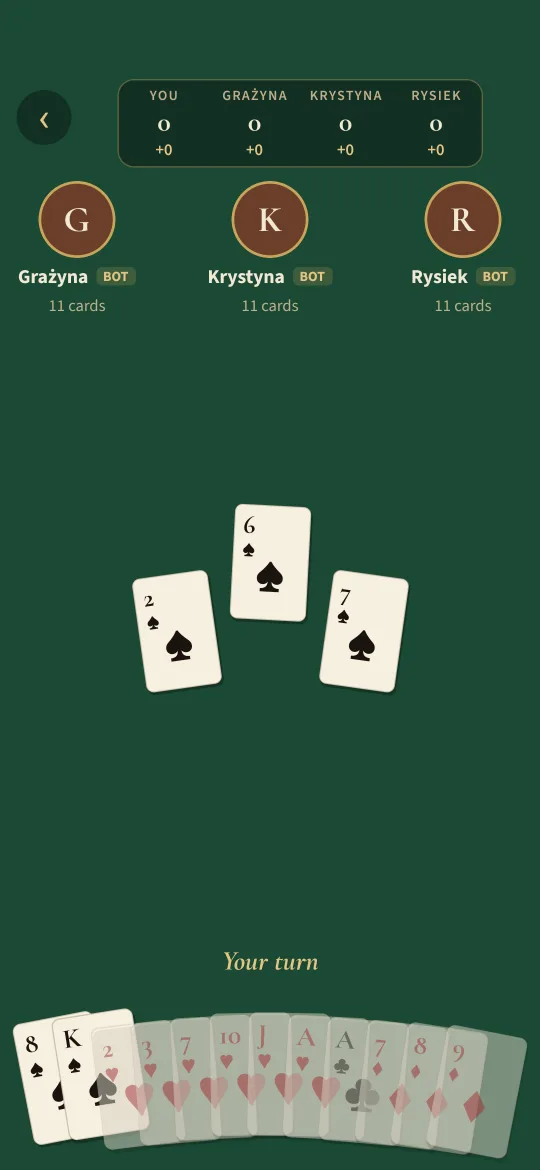
Only when you hold neither the suit nor a trump may you discard anything. Cards you are not allowed to play are dimmed.
Bomb
Instead of playing out a hopeless deal you may throw a bomb. The deal is void: the declarer scores nothing and each opponent adds 60 points.
Every player gets one bomb per game.
Scoring a deal
A declarer who takes at least the declared amount adds it to their score. A declarer who falls short subtracts it — even if they missed by a single point.
Opponents add what they took in tricks and melded, rounded to the nearest ten.
The barrel
The barrel starts at the threshold chosen before the game: 800, 900 or never. Whoever crosses it first sits on the barrel, and their score is trimmed back to exactly the threshold — 810 becomes 800.
On the barrel you only score by making your own contract. Other people’s deals bring you nothing.
Only one player sits on the barrel at a time. There are four ways off: reaching 1000, losing your own contract and dropping below the threshold, spending three deals on it (−120), or being knocked off by somebody who has just climbed on (−120).
Three zeros
Three deals in a row in which you took no points as an opponent cost you 120 points.
Deals ended by a bomb do not count, nor do deals spent on the barrel.
End of the game
The game is won by the player who reaches 1000 as declarer, making their declaration. Drifting past 1000 on other people’s deals is not enough — the last points must come from your own game.
Playing without the barrel, anyone crossing 1000 wins, opponents included.
 Hearts
 Classic solitaire
 FreeCell